Electrolytes for Triathletes

Triathlon combines swimming, cycling and running into one continuous event, which can create different hydration and fuelling demands from training or racing in a single discipline.
Water and electrolytes can be lost through sweat throughout the race, but this does not mean every triathlon session or event requires the same electrolyte strategy.
The relevance of electrolytes depends on factors including race or session duration, environmental conditions, individual sweat losses, exercise intensity, opportunities to drink and the time available for recovery.
For triathletes, hydration also has to fit alongside carbohydrate fuelling and the practical demands of moving between three different disciplines.
Do triathletes need electrolytes for every training session?
Not necessarily.
Triathlon training can include very different sessions, such as:
- Easy swimming
- Short runs
- Strength training
- Indoor cycling
- Longer bike rides
- Brick sessions
- Long runs
- Open-water swimming
- Double training days
- Long race-specific sessions
For many shorter, easier or lower-sweat sessions, normal meals, water and everyday fluid intake may be sufficient.
Electrolytes may become more relevant when:
- Sessions are prolonged
- Sweat losses are high
- Conditions are warm or humid
- Multiple disciplines are combined
- Several sessions are completed on the same day
- Recovery time before the next demanding session is limited
- Meaningful fluid and sodium losses need to be replaced
The decision should therefore reflect the athlete, the session and the conditions rather than simply the fact that the athlete is training for a triathlon. Sweat losses can vary considerably both between athletes and within the same athlete under different conditions. [1][2]
Why does triathlon create different hydration demands?
Triathlon requires athletes to complete swimming, cycling and running consecutively.
This creates several practical considerations.
The athlete cannot normally drink during the swim, while the cycling section generally provides considerably more opportunity to carry and consume fluid. Drinking during the run may then be limited by aid-station access, pace, gastrointestinal comfort and the athlete's ability to consume fluid after several hours of exercise.
Longer triathlons can also involve substantially more time exercising than many standalone running or cycling events.
The athlete therefore needs to consider the entire race, rather than creating completely separate hydration plans for the swim, bike and run.
Relevant factors include:
- Total race duration
- Time spent in each discipline
- Temperature and humidity
- Individual sweat losses
- Opportunities to drink
- Bottle capacity and refill points
- Aid-station availability
- Carbohydrate intake
- Gastrointestinal comfort
- Starting hydration status
- Previous training or travel
Endurance-sport research identifies dehydration, carbohydrate depletion, gastrointestinal problems, heat stress and fluid-balance problems as important considerations during prolonged events. [3]
How does triathlon distance affect hydration needs?
Triathlon covers events with very different durations.
A sprint-distance triathlon may create very different fluid and electrolyte demands from a middle-distance or long-course event.
Distance still does not provide the complete answer because race time can vary substantially between athletes.
Two triathletes completing the same event may spend very different amounts of time exercising and may experience different temperatures, sweat losses and opportunities to drink.
For hydration planning, expected race duration, conditions and individual losses are therefore often more useful than distance alone.
Shorter triathlons
During shorter events, there may be less time for substantial fluid and sodium losses to accumulate.
An athlete beginning normally hydrated and racing in moderate conditions may require a much simpler hydration strategy than they would during a long-course event.
This does not mean electrolytes cannot be used. It means their relevance should be judged against the actual demands of the event.
Longer triathlons
As race duration increases, fluid and sodium losses can accumulate, while carbohydrate intake can become a more significant part of the race plan.
Long-course athletes also have to manage intake across several hours without creating gastrointestinal problems or consuming excessive fluid.
Hydration and carbohydrate fuelling therefore need to be considered together, particularly during the cycling section where much of the athlete's planned intake may occur. Endurance nutrition guidance supports increasing attention to carbohydrate availability as exercise duration increases. [3][4]
Why do individual sweat losses matter?
Sweat rate describes how much sweat an athlete produces over a period of time.
Sweat sodium concentration describes how much sodium is present within that sweat.
They are not the same measurement.
An athlete can have:
- A high sweat rate with a lower sweat sodium concentration
- A lower sweat rate with a higher sweat sodium concentration
- High values for both
- Relatively low values for both
Total sodium loss depends on the total volume of sweat lost and the sodium concentration of that sweat. Exercise duration influences how much sweat can accumulate over the session.
Research shows substantial differences in both sweat rate and sweat sodium concentration between athletes. [1]
This means one fluid or sodium target should not automatically be applied to every triathlete.
Changes in body mass before and after representative training sessions, considered alongside fluid consumed and any urine produced, can help estimate sweat losses.
Results should be treated as useful context rather than permanent prescriptions because losses can change with intensity, environmental conditions and heat acclimatisation.
For a more detailed explanation, read Sodium and Exercise Hydration.
How do heat and humidity affect triathlon hydration?
Warm conditions can increase thermal strain and commonly increase sweat losses.
Humidity can reduce how effectively sweat evaporates from the skin, making heat regulation more difficult.
This can be particularly relevant in triathlon because athletes may be exercising for several hours while environmental conditions change throughout the event.
A race beginning in relatively cool morning conditions may become considerably warmer during the bike or run.
Triathletes should therefore consider the conditions expected across the whole race, rather than only the weather at the start.
A hydration strategy intended for warmer racing should be tested during representative training rather than introduced for the first time on race day. General endurance hydration guidance also emphasises adapting intake to environmental conditions and individual losses. [1][2]
What should triathletes consider during the swim?
The swim creates an obvious practical limitation: athletes generally cannot drink while swimming.
The aim should therefore be to begin the race normally hydrated rather than attempting to compensate with excessive drinking immediately before entering the water.
Athletes should also consider how much time may pass between their final pre-race drink and their first realistic opportunity to drink on the bike.
For longer events, this makes the early cycling section an important part of the overall hydration plan.
However, athletes should not deliberately overdrink before the swim in an attempt to create a fluid reserve. Starting appropriately hydrated is different from forcing excessive fluid intake. [2]
Why is the cycling section important for hydration and fuelling?
The bike generally provides the greatest opportunity to carry and consume fluid during a triathlon.
Cyclists can use bottles, on-course aid stations and additional nutrition stored on the bike, making this section particularly important during longer events.
Triathletes should consider:
- Expected bike duration
- Bottle capacity
- Aid-station or refill availability
- Likely sweat losses
- Weather conditions
- Sodium supplied per serving
- Carbohydrate supplied by drinks
- Carbohydrate supplied by gels, bars or food
- Gastrointestinal comfort
- What still needs to be completed on the run
The goal should not simply be to consume as much as possible while drinking is convenient.
The cycling strategy needs to prepare the athlete for the run without causing excessive fluid intake or gastrointestinal discomfort.
For longer events, carbohydrate intake becomes an important consideration alongside hydration. [3][4]
What should triathletes consider during the run?
The run comes after the athlete has already completed the swim and bike.
Hydration decisions during the run should therefore take into account what has already been consumed and lost earlier in the race.
Athletes should consider:
- Remaining race duration
- Environmental conditions
- How much fluid has already been consumed
- Likely accumulated sweat losses
- Aid-station availability
- Sodium already consumed
- Carbohydrate already consumed
- Gastrointestinal comfort
- Individual thirst and tolerance
Running can also make drinking and eating less comfortable than cycling, particularly at higher intensities.
A race plan should therefore avoid relying on large amounts of fluid or nutrition being consumed during the run if the athlete has not successfully practised that approach.
The bike and run strategies should be developed as parts of the same race plan, not as unrelated sections.
Do triathletes need to replace every fluid and sodium loss during the race?
Not necessarily.
Trying to replace every estimated loss during prolonged endurance exercise may be unnecessary or impractical.
Fluid intake should reflect likely losses, environmental conditions, opportunities to drink and individual tolerance while avoiding both substantial under-replacement and excessive intake. [2][5]
The presence of electrolytes in a drink does not make excessive fluid consumption safe.
This is particularly important in longer endurance events, where athletes have many hours in which excessive intake can accumulate.
The purpose of a hydration strategy is therefore not to create a target that must be consumed regardless of changing conditions.
It should provide a framework that the athlete can adjust appropriately during the event.
What should triathletes compare in an electrolyte product?
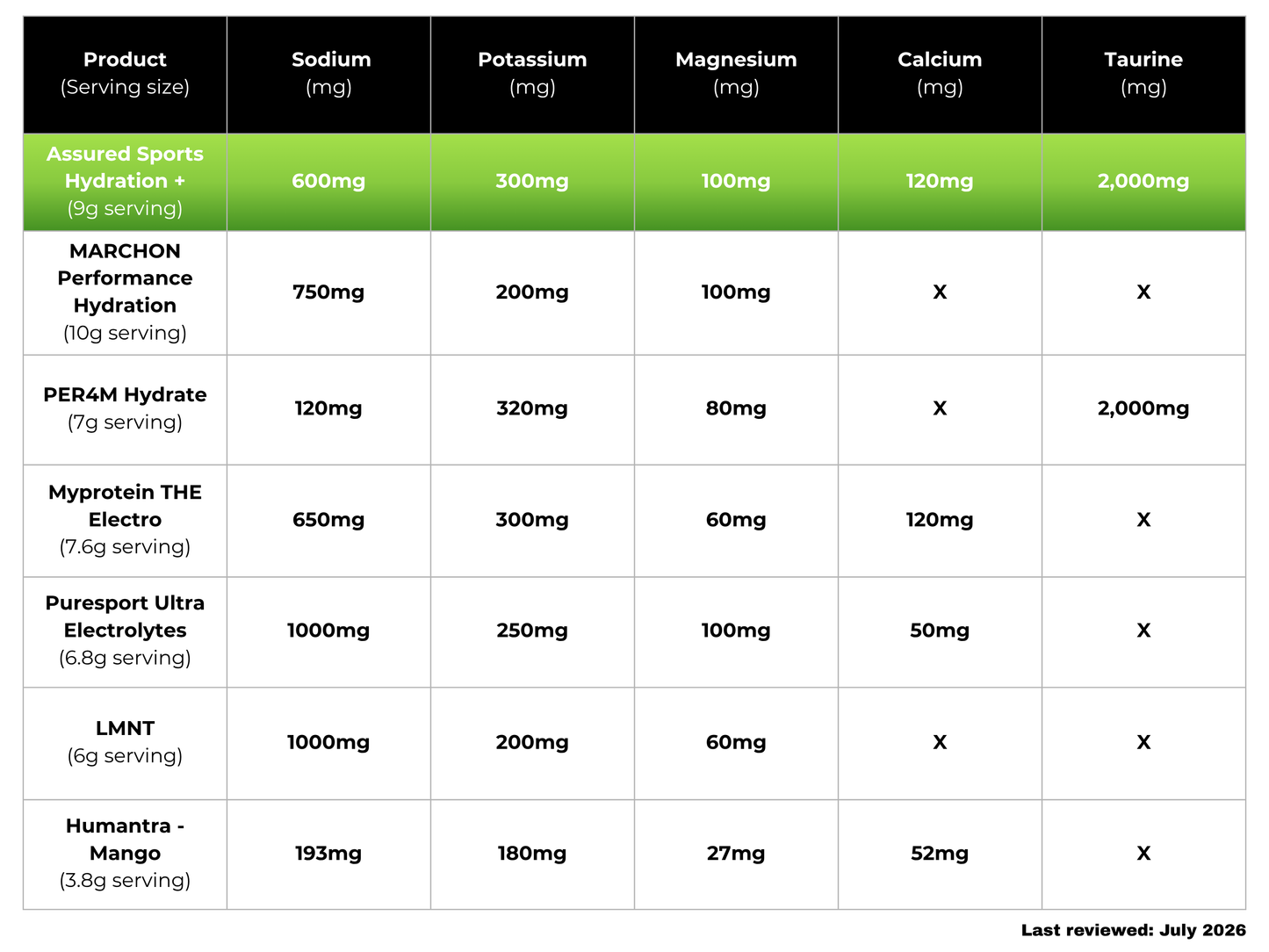
Electrolyte products can provide substantially different formulas even when they are marketed for endurance sport.
Triathletes should compare the declared amounts and intended use rather than relying only on the word "electrolytes" on the front of the product.
Useful comparison points include:
- Sodium per serving
- Other declared electrolytes
- Carbohydrate content
- Additional ingredients
- Serving size
- Mixing instructions
- Number of servings likely to be required
- Practicality during training and racing
Sodium per serving
Sodium is generally the main electrolyte lost through sweat, making the amount provided per serving an important comparison point.
Products can provide very different amounts of sodium.
A higher sodium amount is not automatically better for every triathlete.
The declared amount should be considered alongside:
- Expected sweat losses
- Race or session duration
- Environmental conditions
- Fluid intake
- Sodium obtained from other drinks and food
- Recovery requirements
Triathletes should therefore compare the actual sodium amount provided per serving rather than assuming similar electrolyte products provide similar quantities. [1][2]
Carbohydrate content
Some electrolyte products provide meaningful amounts of carbohydrate while others contain little or none.
This distinction is particularly important in triathlon because carbohydrate intake can become a major component of longer race strategies.
A carbohydrate-electrolyte sports drink can contribute fluid, electrolytes and carbohydrate simultaneously.
A low-carbohydrate or carbohydrate-free electrolyte drink allows hydration and carbohydrate fuelling to be managed separately using gels, bars, food or other products.
Neither approach is automatically better.
The athlete should consider where carbohydrate is coming from across the entire race plan, rather than assessing the electrolyte drink in isolation. [3][4]
Other electrolytes and additional ingredients
Electrolyte products may also provide potassium, magnesium, calcium and other ingredients.
Having more types of electrolytes or additional ingredients does not automatically make a product more suitable for triathlon.
Triathletes should look at the declared amounts and distinguish between:
- Electrolytes
- Carbohydrates
- Amino acids or other additional ingredients
- Flavourings and sweeteners
Additional ingredients should be considered separately rather than assumed to improve hydration simply because they appear in an electrolyte product.
Practicality
A suitable formula also has to work during training and competition.
Triathletes should consider:
- Ease of preparation
- Bottle compatibility
- Ability to carry additional servings
- Aid-station availability
- Taste over several hours
- Compatibility with gels, bars and food
- Ease of using the product around transitions
- Gastrointestinal comfort
A product that looks appropriate on the label still needs to fit realistically into the athlete's race plan.
How should triathletes approach hydration before a race?
The main goal before racing is to begin normally hydrated.
Normal meals and drinks may be sufficient for many athletes.
Additional attention to fluid and sodium may become more relevant when:
- Previous training has caused substantial losses
- Travel has disrupted normal eating and drinking
- Conditions are expected to be warm
- The athlete tends to sweat heavily
- The event is expected to last several hours
- Normal food and fluid intake has been restricted
The answer is not to force a large amount of fluid immediately before the swim.
Any planned pre-race electrolyte strategy should be tested before representative training sessions or lower-priority races. [2]
What should triathletes consider after a race?
Post-race hydration depends on how much fluid and sodium were lost and how quickly the athlete needs to recover.
Normal meals and drinks may be sufficient when losses are modest and there is plenty of recovery time.
A more deliberate rehydration strategy may become relevant when:
- Race duration was long
- Conditions were warm
- Sweat losses were substantial
- Body-mass changes suggest meaningful fluid loss
- Another race or demanding training session is scheduled soon
- Normal food and fluid intake will be delayed
Sodium can be replaced through both food and electrolyte-containing drinks.
Following meaningful exercise-induced dehydration, sodium-containing drinks can support greater fluid retention than plain water under some conditions. The outcome also depends on the amount consumed, food intake and the recovery period. [6]
Fluid, electrolytes, carbohydrate and normal food intake should therefore be considered together rather than treating electrolyte replacement as the entire recovery strategy.
How should a triathlete practise a hydration strategy?
Race day should not be the first time an athlete tests their hydration and fuelling plan.
Representative training sessions and brick sessions can be used to practise:
- Pre-session drinking
- Electrolyte timing
- Bottle setup
- Drinking while cycling
- Carbohydrate intake
- Moving from bike nutrition to run nutrition
- Gastrointestinal tolerance
- Aid-station decisions
- Post-session rehydration
Longer race-specific sessions are particularly useful because problems that do not appear during a short training session may become relevant after several hours.
The objective is not to create one rigid plan that can never change.
It is to build a familiar hydration and fuelling strategy that can be adjusted for race distance, weather, course conditions and individual needs.
Where does Hydration+ fit?
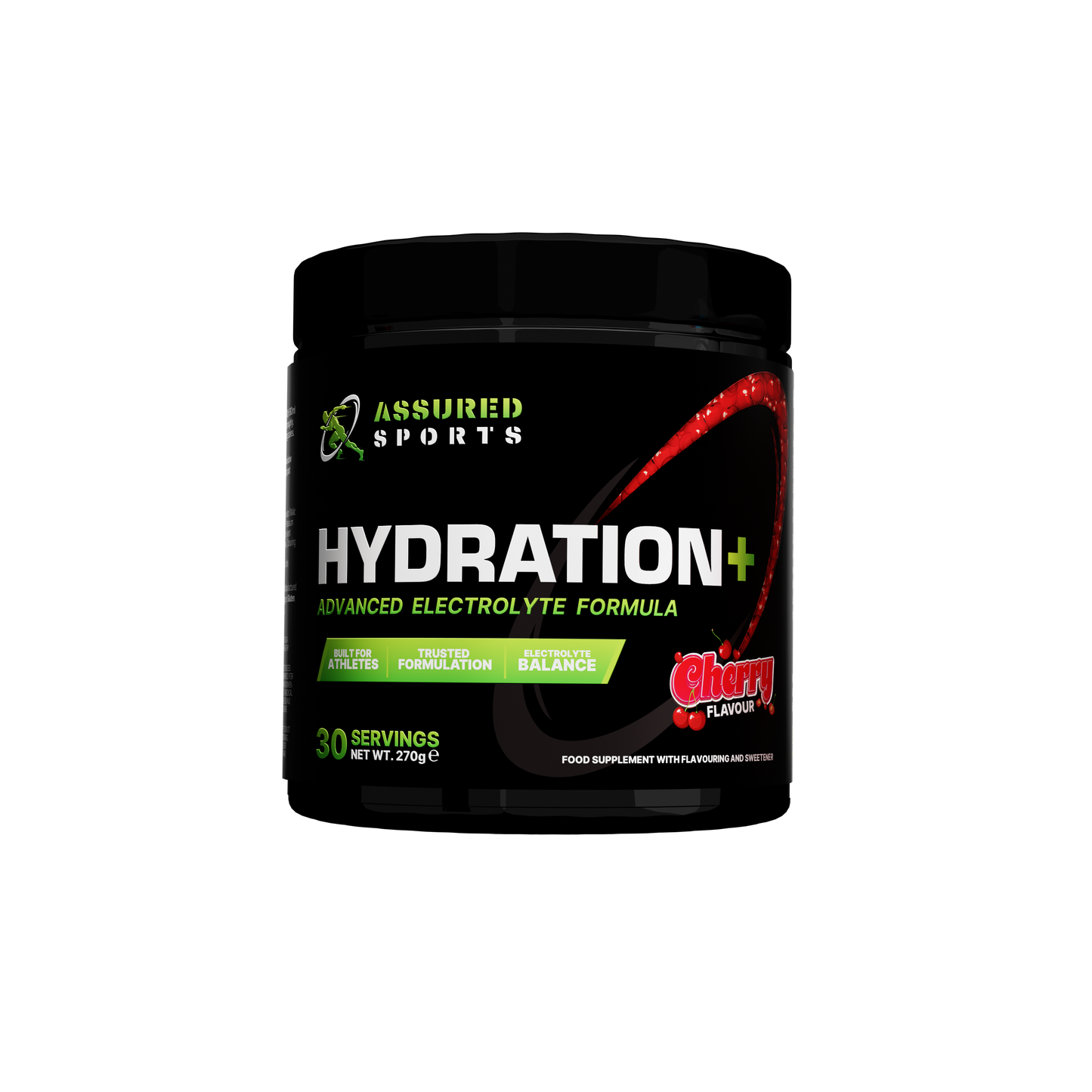
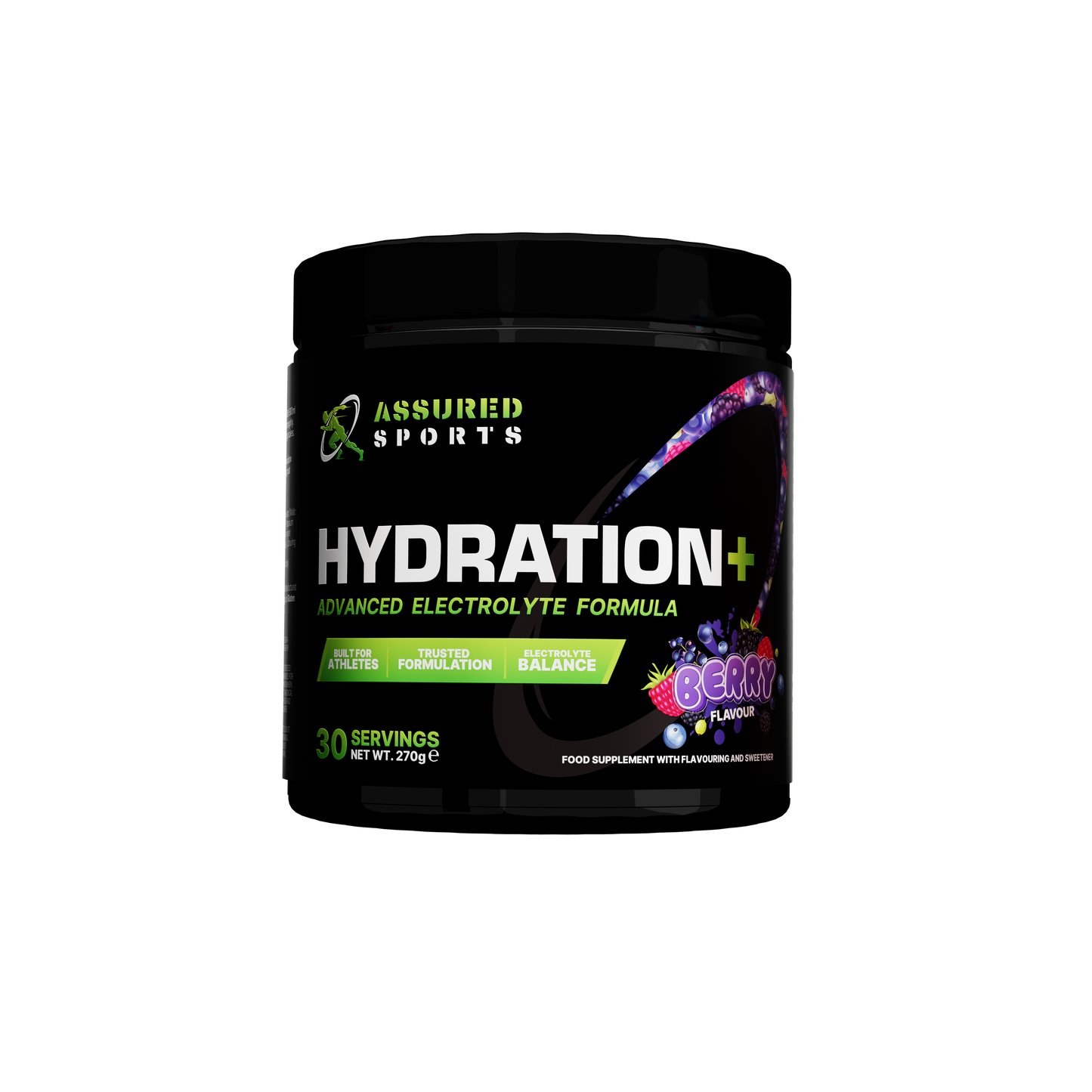
Assured Sports Hydration+ is a powdered electrolyte supplement designed to be mixed with water.
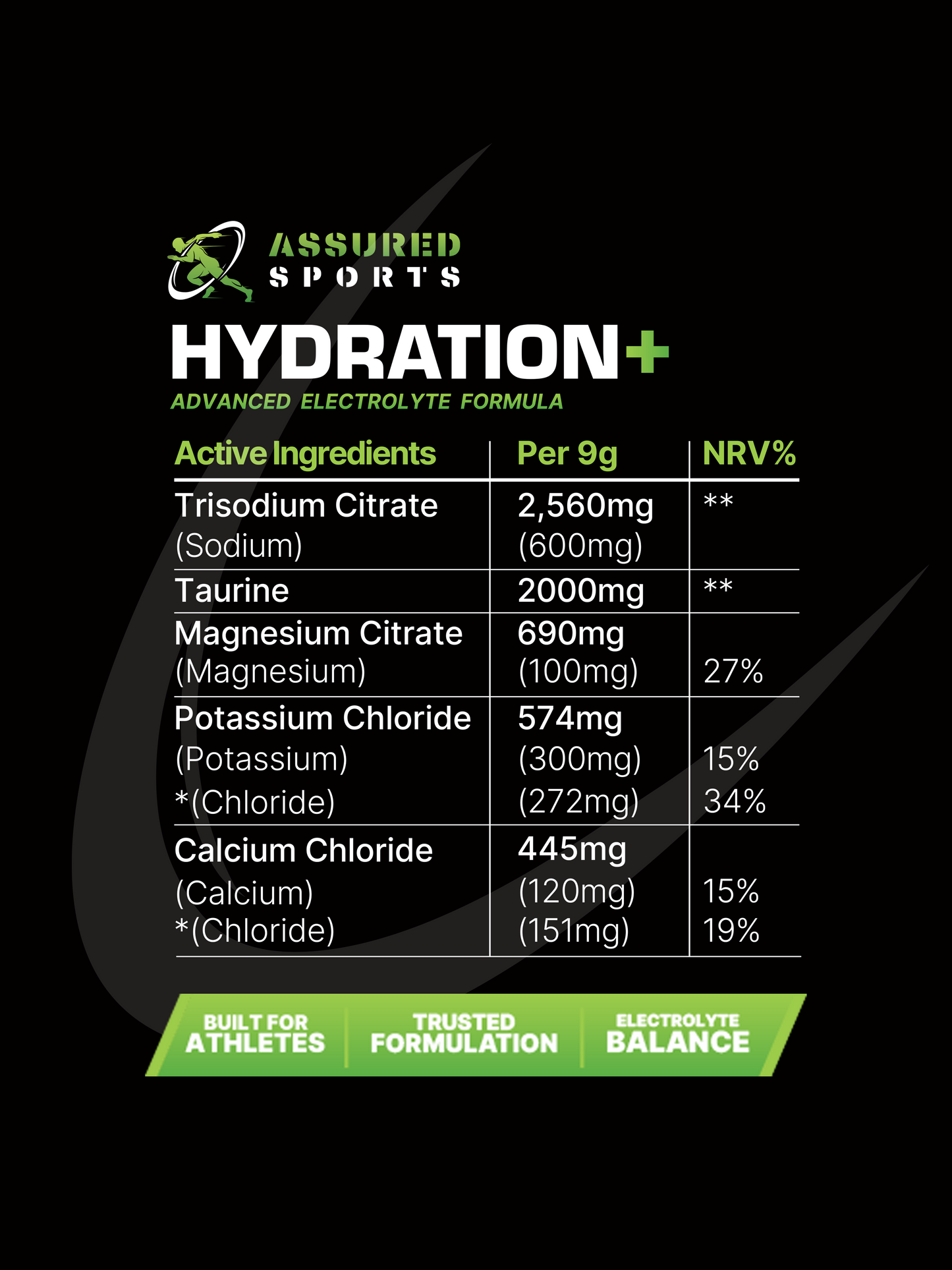
Each 9 g serving provides:
- 600 mg sodium
- 300 mg potassium
- 100 mg magnesium
- 120 mg calcium
- 2,000 mg taurine
Taurine is included as an additional ingredient and is not itself an electrolyte.
For triathletes, the 600 mg sodium per serving provides a clearly declared amount that can be considered alongside expected sweat losses, training or race duration, environmental conditions and sodium obtained from food or other drinks.
Hydration+ may be particularly relevant around long rides, brick sessions, high-sweat training, double training days and longer triathlon events, where fluid and electrolyte replacement can require greater consideration.
It also allows hydration to be managed separately from carbohydrate fuelling. Hydration+ is not a carbohydrate fuelling product, so athletes completing prolonged training or racing should still consider where their carbohydrate intake is coming from.
This separation can be useful for triathletes who prefer to obtain carbohydrate from gels, bars, food or other sports nutrition products while using an electrolyte drink as part of their hydration strategy.
Hydration+ should not be treated as an exact replacement target for every triathlete or session, and it is not necessary for every workout. Requirements depend on the athlete, the event, the session and the conditions.
View Assured Sports Hydration+
Key takeaways
- Not every triathlon session requires an electrolyte product.
- Race duration, environmental conditions, sweat losses and recovery demands all influence hydration requirements.
- Triathletes should consider the swim, bike and run as parts of one complete hydration and fuelling strategy.
- The bike generally provides the greatest practical opportunity to consume fluid and nutrition.
- Sodium per serving is a useful comparison point, but a higher-sodium product is not automatically better for every athlete.
- Carbohydrate-electrolyte drinks and electrolyte-only products do not always serve the same purpose.
- Longer triathlons require greater planning around fluid, sodium, carbohydrate and practical access to nutrition.
- Electrolytes do not make excessive fluid intake safe.
- Normal meals and drinks may be sufficient when losses are modest and recovery time is not restricted.
- Race-day hydration and fuelling strategies should be practised during representative training.
Related guides
For a basic explanation of the main electrolytes, read: What Are Electrolytes?
For more detail on fluid balance and rehydration, read: How Do Electrolytes Help With Hydration?
For a closer look at sweat sodium losses and sodium replacement, read: Sodium and Exercise Hydration
For running-specific hydration considerations, read: Electrolytes for Running
For cycling-specific hydration considerations, read: Electrolytes for Cycling
Sources
[1] Baker LB. Sweating Rate and Sweat Sodium Concentration in Athletes: A Review of Methodology and Intra/Interindividual Variability. Sports Medicine. 2017;47(Suppl 1):111–128.
[2] Sawka MN, Burke LM, Eichner ER, Maughan RJ, Montain SJ and Stachenfeld NS. American College of Sports Medicine Position Stand: Exercise and Fluid Replacement. Medicine & Science in Sports & Exercise. 2007;39(2):377–390.
[3] Jeukendrup AE. Nutrition for Endurance Sports: Marathon, Triathlon, and Road Cycling. Journal of Sports Sciences. 2011;29(Suppl 1):S91–S99.
[4] Burke LM, Hawley JA, Wong SHS and Jeukendrup AE. Carbohydrates for Training and Competition. Journal of Sports Sciences. 2011;29(Suppl 1):S17–S27.
[5] Hew-Butler T, Rosner MH, Fowkes-Godek S, et al. Exercise-Associated Hyponatremia: 2017 Update. Frontiers in Medicine. 2017;4:21.
[6] Shirreffs SM, Taylor AJ, Leiper JB and Maughan RJ. Post-Exercise Rehydration in Man: Effects of Volume Consumed and Drink Sodium Content. Medicine & Science in Sports & Exercise. 1996;28(10):1260–1271.