Sodium and Exercise Hydration

Sodium is an electrolyte found mainly in the fluid outside the body's cells. During exercise, sodium is lost in sweat alongside water, which is why it receives particular attention in sports hydration.
However, sodium requirements are not identical for every athlete or session. The amount lost depends on how much someone sweats, the sodium concentration of that sweat and how long the exercise lasts.
What role does sodium play in the body?
Sodium is the main positively charged electrolyte in extracellular fluid—the fluid outside the body's cells.
It contributes to the regulation of extracellular fluid volume and concentration. Differences in sodium and other electrolyte concentrations across cell membranes are also involved in normal nerve and muscle function. [1][4]
The body carefully regulates sodium and water balance through mechanisms involving thirst, the kidneys and hormones. Sodium intake, fluid intake and losses through urine and sweat all influence this balance.
How is sodium lost during exercise?
Sweating helps the body release heat during exercise. Sweat contains water and several electrolytes, but sodium is generally the electrolyte lost in the greatest quantity.
As sweat travels through the sweat gland, some sodium is reabsorbed before the sweat reaches the skin. The amount ultimately lost therefore differs between individuals and can also change under different conditions. [1]
Sodium loss during a session depends on three connected factors:
- Sweat rate
- Sweat sodium concentration
- Exercise duration
A person who sweats heavily does not automatically have highly concentrated sweat. Equally, someone with a lower sweat rate may still lose a meaningful amount of sodium if their sweat sodium concentration is relatively high.
Why do sweat sodium losses vary?
Both sweat rate and sweat sodium concentration vary considerably between athletes.
Differences can be influenced by factors including:
- Individual physiology
- Exercise intensity
- Environmental temperature and humidity
- Heat acclimatisation
- Differences between training sessions and sports
Research involving athletes across different sports shows wide variation in sweat rate, sweat sodium concentration and total sodium loss. This variation is why one sodium-replacement target should not be assumed to suit everyone. [1][2][3]
The way sweat is measured can also affect the result. Factors such as the body area sampled and the collection method can influence the estimated sweat sodium concentration, which is why sweat-test results should be interpreted in context.
How is total sodium loss estimated?
Total sodium loss depends on two main things:
- The total volume of sweat lost
- The concentration of sodium in that sweat
Exercise duration still matters because it influences how much total sweat can accumulate over the session.
In simple terms:
Total sodium loss = total sweat volume × sweat sodium concentration
This calculation can help estimate the amount lost during a particular session, but it is still an estimate. Sweat testing methods, collection sites and session conditions can all affect the result. [1][2]
A measurement from one session should therefore not automatically be treated as a permanent requirement for every type of training or competition.
Does sodium need to be replaced during every workout?
Not necessarily.
Water and an ordinary diet may be sufficient for shorter, easier or lower-sweat sessions, particularly when someone begins adequately hydrated and has enough time to eat and drink normally afterwards.
Whether sodium replacement is useful depends on factors including:
- Exercise duration
- Environmental conditions
- Sweat rate
- Sweat sodium concentration
- Starting hydration status
- The time available for recovery
A sodium-containing drink should therefore be selected according to the demands of the session rather than used automatically for every workout. [5][6]
When might sodium replacement become more relevant?
Replacing sodium may become more relevant when:
- Exercise is prolonged
- Conditions are hot or humid
- Sweat rate is high
- Sweat sodium concentration is relatively high
- Several sessions are completed within a short period
- There is limited time to eat, drink and recover before the next session
This does not necessarily mean that every milligram of sodium lost must be replaced during exercise.
Some fluid and sodium losses may be replaced during the session, while the remainder can be restored afterwards through drinks, meals and snacks. The appropriate approach depends on the individual and the recovery time available. [1][2][5][7]
Should sodium intake match sweat sodium loss exactly?
Not necessarily.
Estimating sweat sodium loss can help inform a hydration strategy, but the result should not automatically be treated as an exact replacement target.
Sweat testing has practical limitations. Results can be affected by:
- The sweat collection method
- The body area tested
- Environmental conditions
- Exercise intensity
- Heat acclimatisation
- Differences between sessions
A sodium strategy should also consider fluid intake, exercise duration, gastrointestinal comfort, access to drinks and the opportunity to replace losses after exercise.
Exact one-for-one sodium replacement during a session may therefore be neither necessary nor practical. [1][3][5]
Can food help replace sodium after exercise?
Yes.
Ordinary meals and snacks can provide sodium alongside fluid, carbohydrate, protein and other nutrients needed during recovery.
When sweat losses are relatively low and there is no urgency to recover, normal eating and drinking may be sufficient to restore fluid and electrolyte balance.
Sodium-containing foods may include:
- Bread
- Soups
- Sauces
- Cheese
- Salted meals and snacks
The total sodium content varies considerably between foods, so these examples are not fixed recommendations.
When rapid rehydration is required, consuming fluid alongside sodium-containing food—or using a suitable sodium-containing drink—may support greater fluid retention than drinking plain water alone. [5][7][8]
What role does sodium play in post-exercise rehydration?
Following meaningful sweat losses, successful rehydration involves replacing both fluid and electrolytes.
Drinking a large amount of plain water after exercise can increase urine production before all the fluid and sodium lost through sweat have been restored.
Controlled studies have shown that adding sodium to a rehydration drink can improve fluid retention after exercise-induced dehydration.
The result is influenced by both:
- The sodium concentration of the drink
- The total volume of fluid consumed
Sodium should therefore be considered as one part of the full recovery strategy rather than viewed separately from fluid intake, food and recovery time. [8][9]
Does more sodium always mean better hydration?
No.
The usefulness of sodium depends on the amount lost, the amount of fluid consumed and the demands of the exercise and recovery period.
A higher-sodium product is not automatically the most appropriate choice for every person or session. Sodium intake should be considered against:
- Expected sweat losses
- Session duration
- Environmental conditions
- Food intake
- Recovery time
- Individual tolerance
Sodium also does not make excessive fluid intake safe. Overdrinking can dilute the sodium concentration in the blood and contribute to exercise-associated hyponatraemia.
A sodium-containing drink cannot be relied upon to prevent this if fluid is consumed substantially beyond what is required. [5][10]
Where does Hydration+ fit?
Assured Sports Hydration+ is a powdered electrolyte supplement designed to be mixed with water.
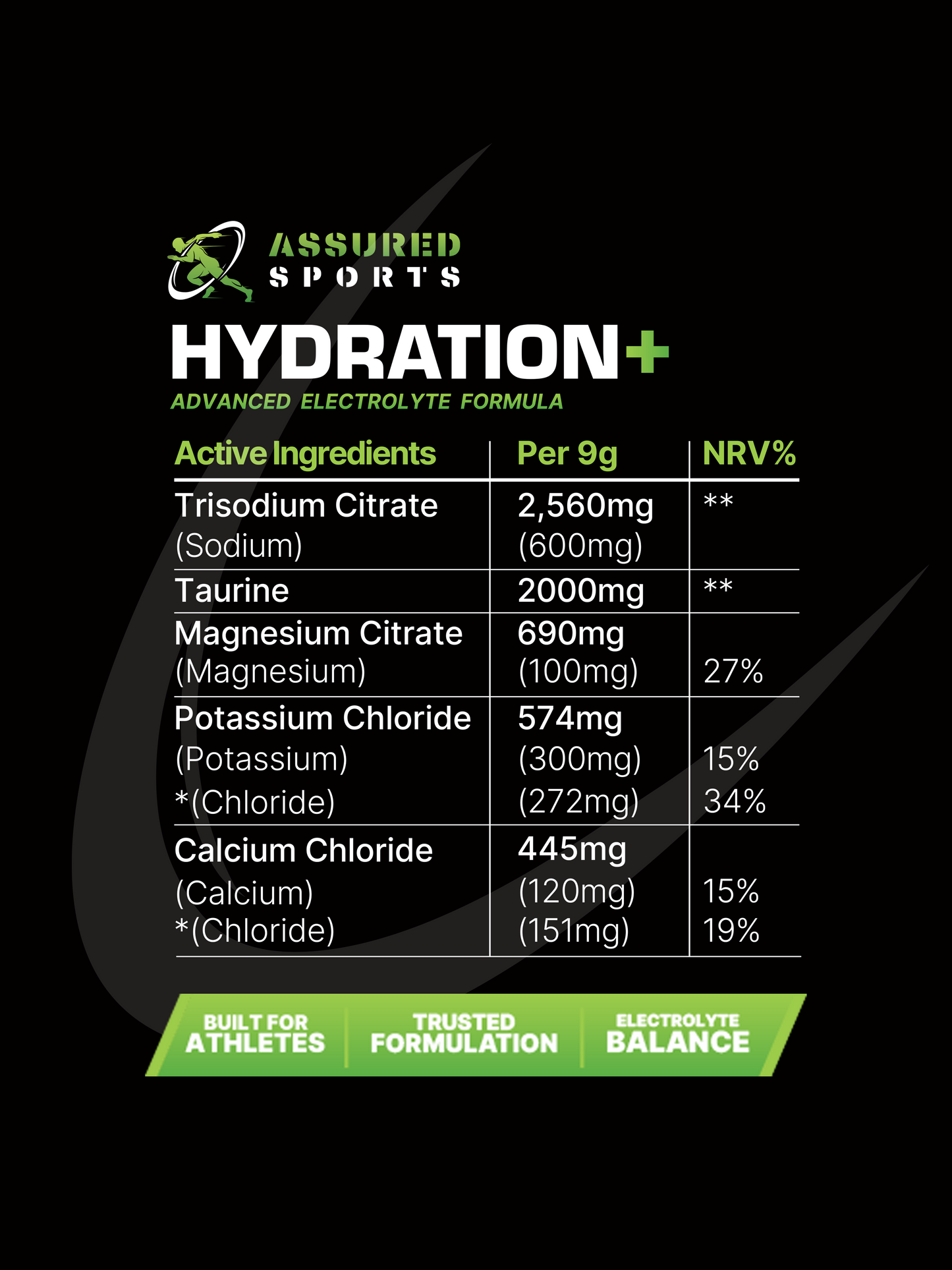
Each 9 g serving provides:
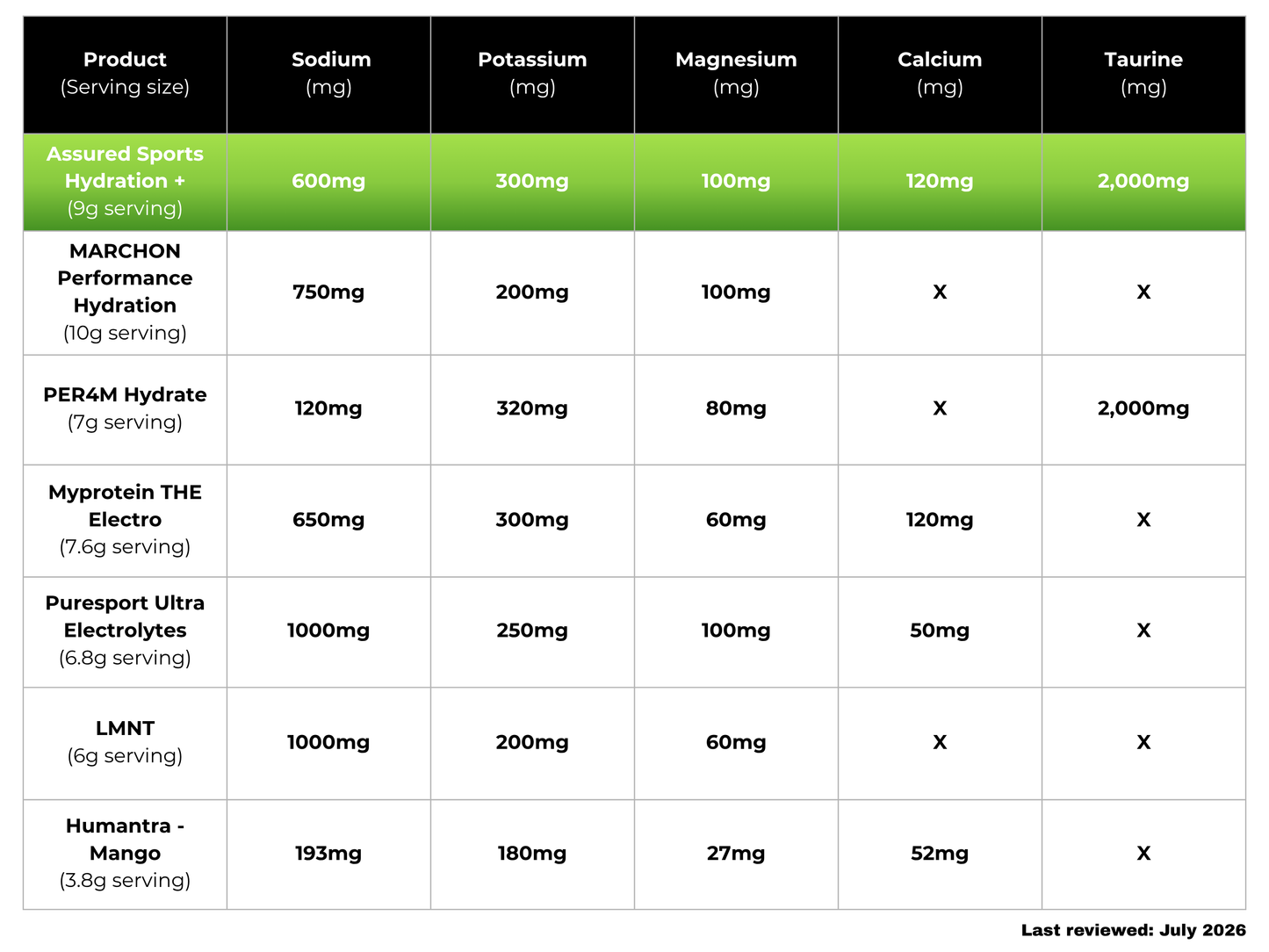
- 600 mg sodium
- 300 mg potassium
- 100 mg magnesium
- 120 mg calcium
- 2,000 mg taurine
Taurine is included as an additional ingredient and is not itself an electrolyte.
The 600 mg sodium amount should be assessed in the context of the individual, the session and the wider hydration strategy. It should not be treated as an exact replacement target for every athlete or workout.
Hydration+ does not remove the need to consume sufficient fluid and is not necessary for every training session. It may be considered around prolonged, hot, high-sweat or repeated sessions where replacing fluid and sodium becomes more relevant.
View Assured Sports Hydration+
Key takeaways
- Sodium is the main positively charged electrolyte in fluid outside the body's cells.
- Water and sodium are both lost through sweat during exercise.
- Total sodium loss depends on sweat rate, sweat sodium concentration and exercise duration.
- Sweat and sodium losses vary considerably between people and sessions.
- Sodium replacement is not necessary during every workout.
- Sweat-testing results should inform rather than dictate an exact replacement target.
- Food and normal meals can contribute to replacing sodium after exercise.
- Sodium-containing drinks may improve fluid retention during post-exercise rehydration under some conditions.
- More sodium is not automatically better, and sodium does not make excessive fluid intake safe.
Related guides
For a broader introduction to electrolytes, read:
For more detail on fluid balance and rehydration, read:
How Do Electrolytes Help With Hydration?
Sources
- Baker LB. Sweating Rate and Sweat Sodium Concentration in Athletes: A Review of Methodology and Intra/Interindividual Variability. Sports Medicine. 2017;47(Suppl 1):111–128.
- Baker LB, Barnes KA, Anderson ML, Passe DH and Stofan JR. Normative Data for Regional Sweat Sodium Concentration and Whole-Body Sweating Rate in Athletes. Journal of Sports Sciences. 2016;34(4):358–368.
- Barnes KA, Anderson ML, Stofan JR, et al. Normative Data for Sweating Rate, Sweat Sodium Concentration, and Sweat Sodium Loss in Athletes: An Update and Analysis by Sport. Journal of Sports Sciences. 2019;37(20):2356–2366.
- European Food Safety Authority. Dietary Reference Values for Sodium. EFSA Journal. 2019;17(9):5778.
- McDermott BP, Anderson SA, Armstrong LE, et al. National Athletic Trainers' Association Position Statement: Fluid Replacement for the Physically Active. Journal of Athletic Training. 2017;52(9):877–895.
- Sawka MN, Burke LM, Eichner ER, Maughan RJ, Montain SJ and Stachenfeld NS. American College of Sports Medicine Position Stand: Exercise and Fluid Replacement. Medicine & Science in Sports & Exercise. 2007;39(2):377–390.
- Maughan RJ, Leiper JB and Shirreffs SM. Restoration of Fluid Balance After Exercise-Induced Dehydration: Effects of Food and Fluid Intake. European Journal of Applied Physiology and Occupational Physiology. 1996;73(3–4):317–325.
- Shirreffs SM, Taylor AJ, Leiper JB and Maughan RJ. Post-Exercise Rehydration in Man: Effects of Volume Consumed and Drink Sodium Content. Medicine & Science in Sports & Exercise. 1996;28(10):1260–1271.
- Evans GH, James LJ, Shirreffs SM and Maughan RJ. Optimizing the Restoration and Maintenance of Fluid Balance After Exercise-Induced Dehydration. Journal of Applied Physiology. 2017;122(4):945–951.
- Hew-Butler T, Rosner MH, Fowkes-Godek S, et al. Statement of the Third International Exercise-Associated Hyponatremia Consensus Development Conference, Carlsbad, California, 2015. Clinical Journal of Sport Medicine. 2015;25(4):303–320.