How to Compare Electrolyte Formulas

Electrolyte products can look very similar on the front of the tub, sachet or tube, but the formulas behind them can be very different.
One product may provide a relatively high amount of sodium, while another may focus on magnesium, potassium or additional ingredients.
Some include carbohydrate. Others are designed mainly to provide electrolytes.
This means the most useful way to compare electrolyte supplements is not by looking at the number of ingredients or the size of the serving alone.
The important question is what the product actually provides per serving and whether that formula suits the intended use.
What should you compare in an electrolyte formula?
When comparing electrolyte products, start with the nutrition and ingredient information rather than the marketing on the front of the pack.
Useful points to compare include:
- Sodium per serving
- Potassium per serving
- Magnesium per serving
- Calcium per serving
- Carbohydrate per serving
- Additional active ingredients
- Serving size
- Number of servings
- Product format
- Cost per serving
- Practicality for the intended training or event
Not every product needs to contain all of these.
A formula with more ingredients is not automatically better, and a product with a higher amount of one electrolyte is not automatically more suitable.
The formula needs to be considered in context.
Why is sodium one of the most important numbers to compare?
Sodium is the main electrolyte lost in sweat and is therefore one of the most useful figures to examine when comparing products intended for exercise hydration.
However, sodium losses can vary substantially between people.
They can also vary between sessions because total sweat losses and sweat sodium concentration are not identical for every athlete or every training environment.
This means there is no single sodium amount that makes one product universally better than another.
Instead, sodium per serving can be used to understand how different products compare and how each might fit into an athlete's wider hydration strategy. [1][2]
A product that provides more sodium is not automatically superior.
Likewise, a lower-sodium product is not automatically inadequate.
The relevant question is whether the amount provided is appropriate for the person, the session and the wider plan.
Should you compare potassium, magnesium and calcium too?
Yes, but they should be interpreted alongside sodium rather than simply added together to create a larger "electrolyte total".
Potassium, magnesium and calcium all have important physiological roles, but they are not lost in sweat in the same amounts as sodium.
A product containing all four electrolytes may suit someone who prefers a broader electrolyte formula, but the number of electrolytes included does not by itself determine whether the product is better.
When comparing formulas, look at the declared amount of each electrolyte rather than counting how many appear on the label.
How should carbohydrate be compared?
Carbohydrate can change the role of an electrolyte product.
Some products are designed mainly to provide electrolytes, while others also provide meaningful amounts of carbohydrate and may contribute to fuelling during longer or harder sessions.
That does not make one approach automatically better.
The more suitable option depends on whether the athlete wants one product to contribute to both hydration and fuelling, or prefers to manage carbohydrate separately through gels, food or another drink.
When comparing products, check:
- Carbohydrate per serving
- Whether the carbohydrate amount is meaningful for the intended session
- Whether other carbohydrate sources are already being used
- Whether the product is intended primarily for hydration, fuelling, or both
Carbohydrate needs should be considered as part of the wider fuelling strategy rather than judged from the electrolyte label alone. [3][4]
Do additional ingredients matter?
They can, but only if they are relevant to how the product will be used.
Electrolyte products may also contain ingredients such as:
- Taurine
- Amino acids
- Vitamins
- Caffeine
- Flavourings
- Sweeteners
- Other active ingredients
The presence of additional ingredients does not automatically make a formula better.
A longer ingredient list may look more impressive, but the useful questions are:
- What is the ingredient?
- How much is provided per serving?
- Why is it included?
- Does it suit the intended use?
- Is it something the athlete actually wants in the product?
This is particularly important when comparing products for training or competition, where an athlete may want to control ingredients such as caffeine or carbohydrate separately.
Why does serving size matter?
Serving size helps explain how much product is required to provide the declared formula.
However, a larger serving size does not automatically mean a stronger or better electrolyte product.
For example, two products may use very different serving weights while providing similar amounts of sodium.
Another product may use a larger serving because it contains carbohydrate or additional ingredients.
The useful comparison is therefore not simply the number of grams in the scoop, sachet or tablet.
Instead, compare the nutrients and active ingredients provided by that serving.
Should you compare cost per serving?
Yes.
Pack price alone can be misleading when products contain different numbers of servings.
A more useful comparison is cost per serving alongside what each serving actually provides.
Consider:
- Product price
- Number of servings
- Cost per serving
- Sodium per serving
- Other electrolytes
- Carbohydrate
- Additional ingredients
A cheaper serving is not automatically better value if the formula does not suit the intended use.
Likewise, a more expensive formula is not automatically higher quality.
Value should be considered alongside formula and practicality rather than price alone.
How should practical use affect the comparison?
Formula matters, but a product also needs to be practical to use.
Two electrolyte products may look similar on paper but work differently in practice because of:
- Product format
- Serving method
- Packaging
- Portability
- Ease of preparation
- Taste
- Number of servings
- Whether the product is easy to use during training or competition
These factors do not change the nutritional formula, but they can affect whether the product is realistic for the intended situation.
A formula that looks strong on paper may be less useful if it is inconvenient for the way the athlete plans to train, travel or compete.
Should the highest numbers always win?
No.
Higher amounts of sodium, magnesium, potassium, calcium or additional ingredients do not automatically make a product better.
The same applies to serving size and total ingredient count.
The purpose of comparing formulas is not to find the product with the biggest numbers.
It is to understand what each product provides and decide whether that matches the intended use.
For example:
- A higher-sodium formula may be more relevant in some higher-sweat situations, but it is not automatically necessary for everyone.
- A carbohydrate-containing product may be useful when fuelling is part of the plan, but unnecessary when carbohydrate is being managed separately.
- A formula with several additional ingredients may suit one athlete but be unnecessary for another.
- A simpler formula may be more appropriate when the athlete wants to control other parts of the nutrition strategy separately.
The comparison should therefore remain practical and individual rather than becoming a competition between labels.
How should you read an electrolyte label?
Start with the declared values per serving.
Check:
- Serving size
- Sodium
- Potassium
- Magnesium
- Calcium
- Carbohydrate
- Additional active ingredients
- Number of servings
Then consider whether the stated serving is the amount the athlete is realistically likely to use.
Do not compare one product using a full serving and another using half a serving unless that is how each product is actually intended to be used.
Using the same comparison basis makes it easier to understand how formulas differ.
For this guide, the side-by-side product comparison will use the declared amount per serving for each product.
Electrolyte formula comparison
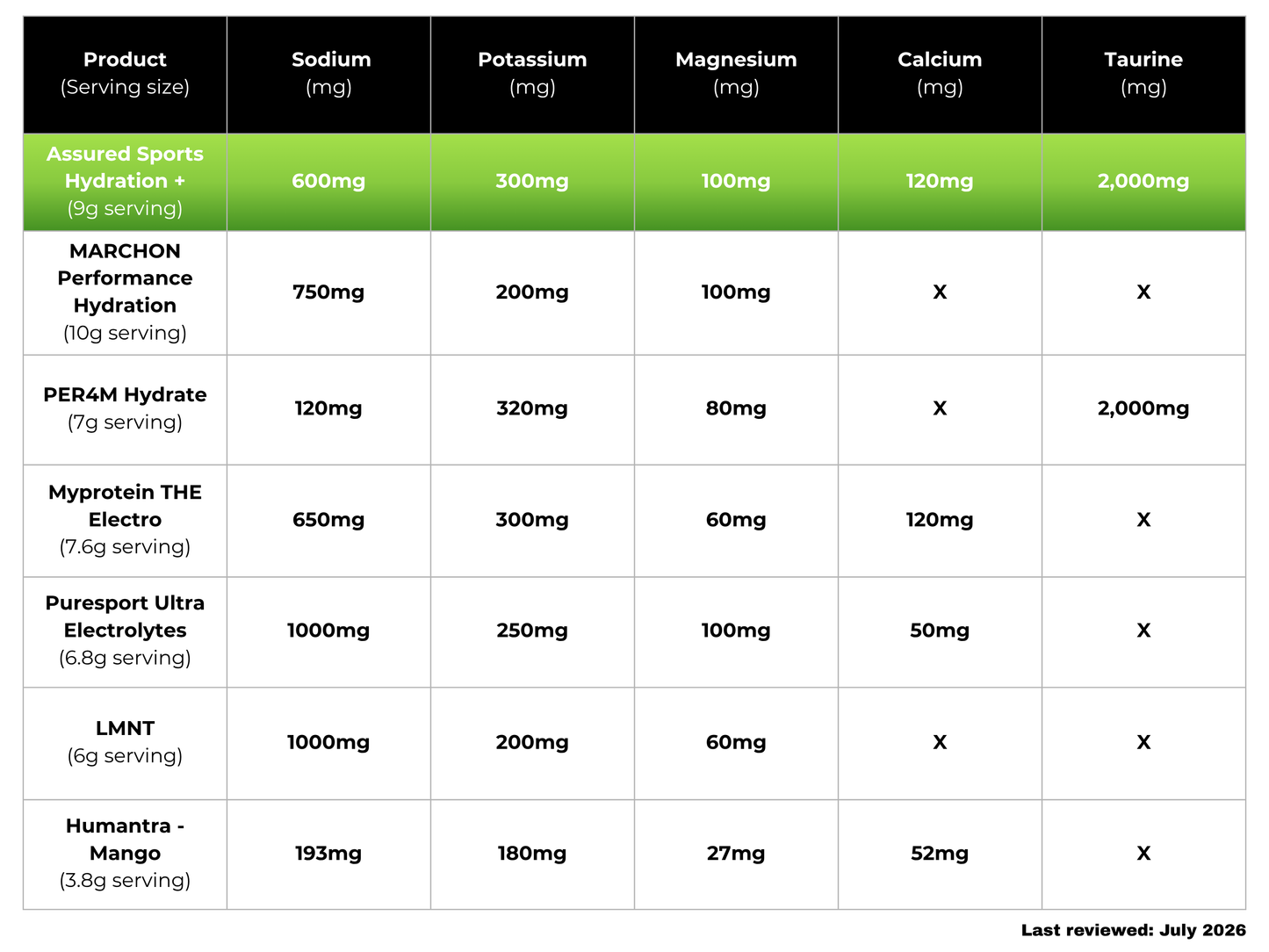
The table below compares the declared amount provided per serving by a selection of electrolyte products.
The purpose is not to rank products from best to worst.
Different formulas may suit different athletes, training demands and fuelling strategies.
The table focuses on the declared serving size and the sodium, potassium, magnesium, calcium and taurine values included in the product information reviewed.
Other factors, including carbohydrate content, other additional ingredients, product format, cost and practicality, may still be important when choosing between products.
Product information last reviewed: July 2026. Product formulas, serving sizes and product information can change, so always check the current manufacturer label before purchasing.
Table values are based on the product information and label data reviewed for this comparison in July 2026. The scientific references at the end of this guide support the general hydration and fuelling discussion rather than the individual manufacturer formula values.
| Product | Serving Size | Sodium | Potassium | Magnesium | Calcium | Taurine |
|---|---|---|---|---|---|---|
| Assured Sports Hydration+ | 9 g | 600 mg | 300 mg | 100 mg | 120 mg | 2,000 mg |
| MARCHON Performance Hydration | 10 g | 750 mg | 200 mg | 100 mg | X | X |
| PER4M Hydrate | 7 g | 120 mg | 320 mg | 80 mg | X | 2,000 mg |
| Myprotein THE Electro | 7.6 g | 650 mg | 300 mg | 60 mg | 120 mg | X |
| Puresport Ultra Electrolytes | 6.8 g | 1,000 mg | 250 mg | 100 mg | 50 mg | X |
| LMNT | 6 g | 1,000 mg | 200 mg | 60 mg | X | X |
| Humantra - Mango | 3.8 g | 193 mg | 180 mg | 27 mg | 52 mg | X |
What does the comparison table show?
The products in this comparison use noticeably different formulas.
Among the products reviewed, sodium per serving ranges from 120 mg in PER4M Hydrate to 1,000 mg in both Puresport Ultra Electrolytes and LMNT.
Other electrolyte amounts also vary.
For example:
- Potassium ranges from 180 mg to 320 mg per serving.
- Magnesium ranges from 27 mg to 100 mg per serving.
- Some of the reviewed formulas include declared calcium values, while others do not have a calcium value included in the comparison data.
- Assured Sports Hydration+ and PER4M Hydrate both provide 2,000 mg taurine per serving in the reviewed data.
These differences do not create a simple ranking.
A higher number in one column does not automatically mean that product is better overall.
Instead, the table shows why electrolyte products should be compared nutrient by nutrient and in the context of how they are intended to be used.
For example, someone specifically looking for a higher sodium intake may assess the table differently from someone who wants a broader combination of sodium, potassium, magnesium and calcium.
The same applies to additional ingredients such as taurine.
What does X mean in the table?
An X does not mean that the product definitely contains zero of that nutrient or ingredient.
It means that a declared value was not included in the verified comparison data used to build this table.
Product labels and manufacturer information should always be checked directly when making a purchasing decision.
Where does Hydration+ fit?
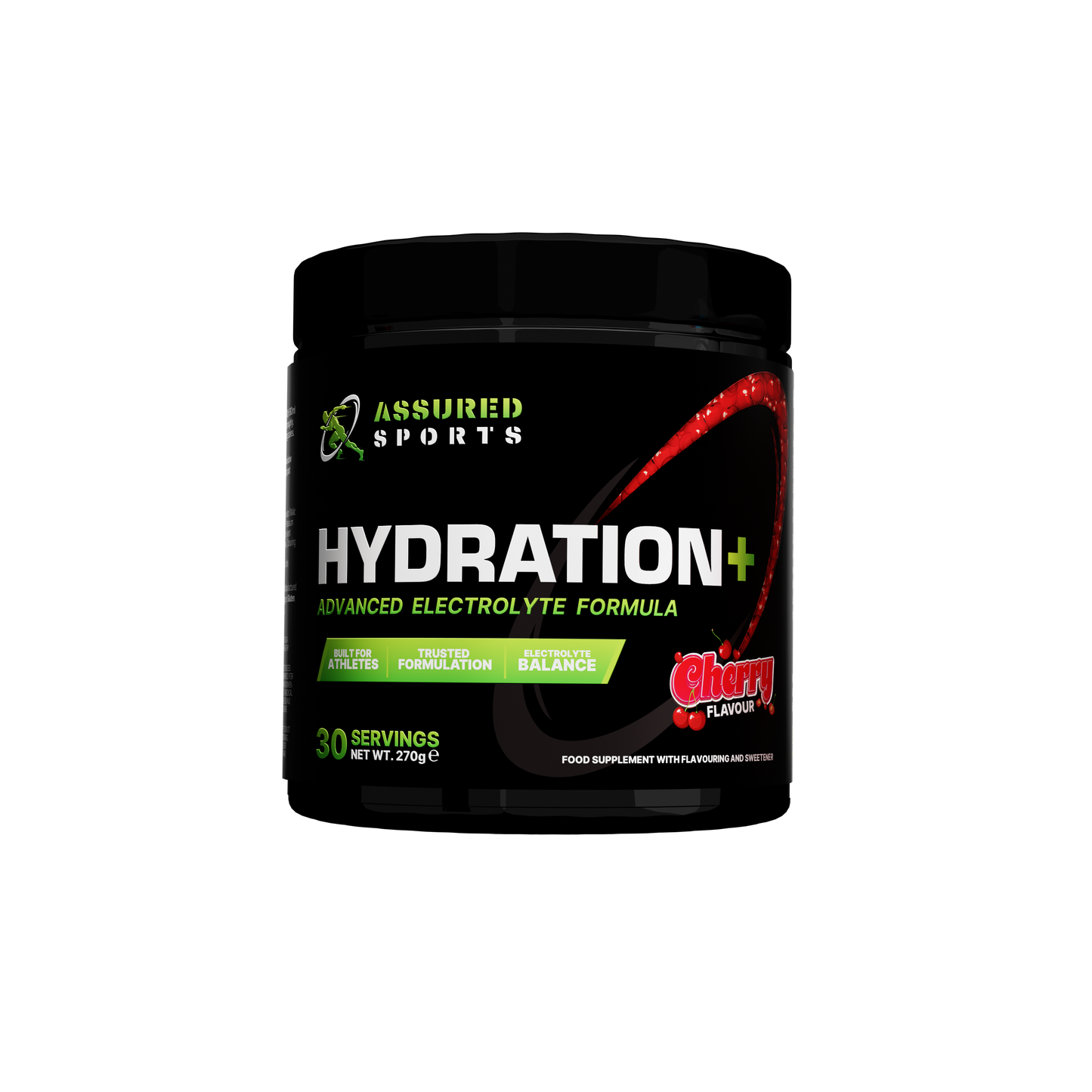
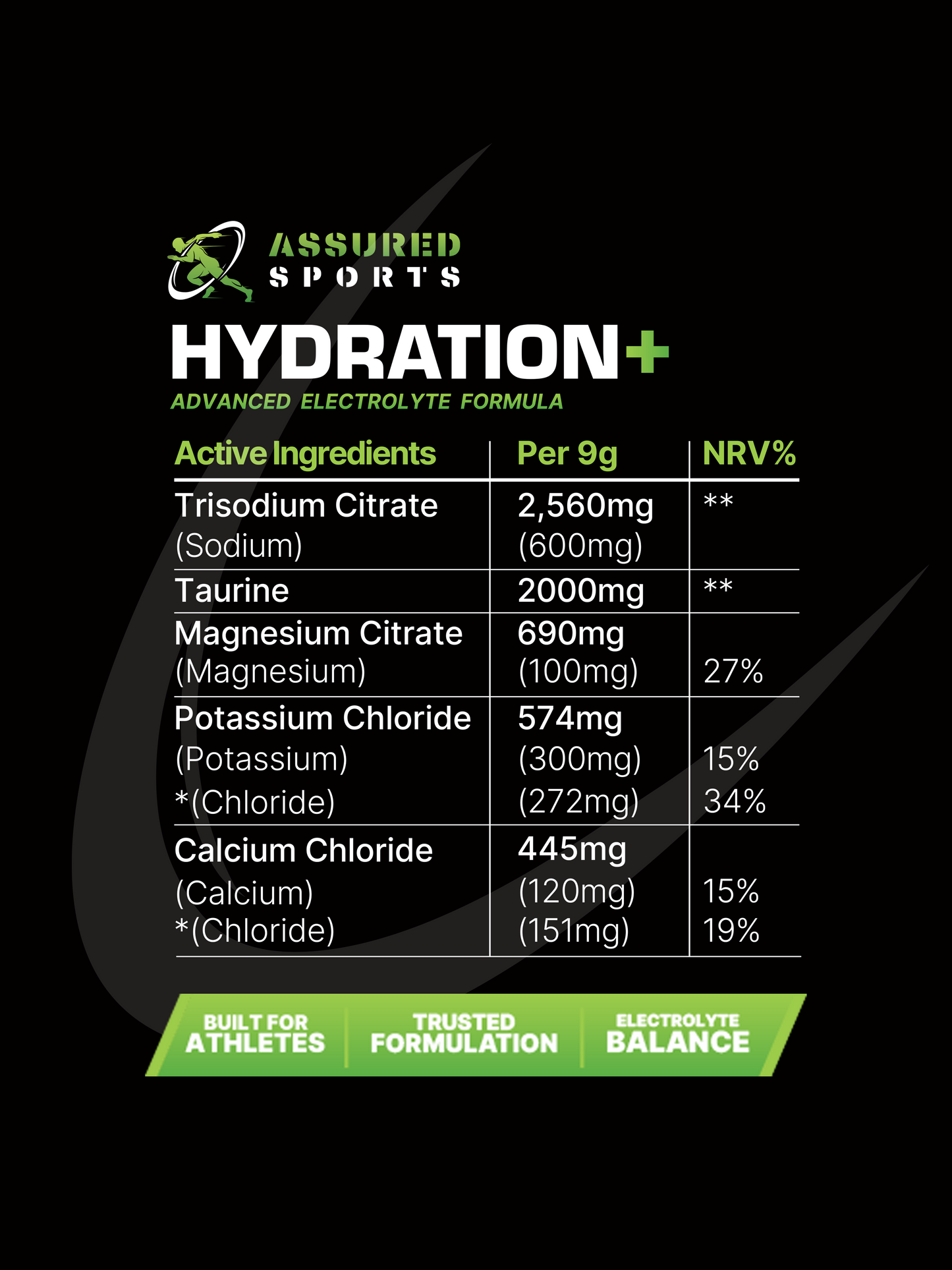
Assured Sports Hydration+ provides, per 9 g serving:
- 600 mg sodium
- 300 mg potassium
- 100 mg magnesium
- 120 mg calcium
- 2,000 mg taurine
Taurine is an additional ingredient and is not an electrolyte.
Within this comparison, Hydration+ sits below the highest-sodium products such as LMNT and Puresport Ultra Electrolytes, while providing more sodium per serving than PER4M Hydrate and Humantra Mango.
It also provides declared amounts of potassium, magnesium and calcium alongside sodium.
That does not make Hydration+ automatically better than the other products in the table.
Its formula may suit athletes who want a powdered electrolyte product containing sodium alongside potassium, magnesium, calcium and taurine, while managing carbohydrate fuelling separately.
The more suitable option still depends on the athlete, expected sweat losses, training demands, wider fuelling strategy and practical preference.
View Assured Sports Hydration+
Key takeaways
- Electrolyte formulas can differ substantially even when products appear similar.
- Sodium per serving is one of the most useful figures to compare for exercise hydration.
- Higher sodium does not automatically mean a product is better for everyone.
- Potassium, magnesium and calcium should be compared individually rather than combined into a simple "electrolyte total".
- Carbohydrate content can change whether a product contributes to fuelling as well as hydration.
- Additional ingredients should be judged by what they provide and whether they are relevant to the intended use.
- Serving size alone does not indicate how strong or suitable a formula is.
- Cost per serving should be considered alongside the actual formula.
- Product format and practicality still matter even when two formulas look similar on paper.
- A useful comparison looks at the complete formula and how it fits the athlete, session and wider nutrition strategy.
Related guides
For broader guidance on choosing an electrolyte supplement, read:
How to Choose an Electrolyte Supplement
For a comparison of different electrolyte formats, read:
For more detail on sodium and exercise hydration, read:
For a basic explanation of electrolytes, read:
Sources
[1] Baker LB. Sweating Rate and Sweat Sodium Concentration in Athletes: A Review of Methodology and Intra/Interindividual Variability. Sports Medicine. 2017;47(Suppl 1):111–128.
[2] McDermott BP, Anderson SA, Armstrong LE, et al. National Athletic Trainers' Association Position Statement: Fluid Replacement for the Physically Active. Journal of Athletic Training. 2017;52(9):877–895.
[3] Jeukendrup AE. Nutrition for Endurance Sports: Marathon, Triathlon, and Road Cycling. Journal of Sports Sciences. 2011;29(Suppl 1):S91–S99.
[4] Burke LM, Hawley JA, Wong SHS and Jeukendrup AE. Carbohydrates for Training and Competition. Journal of Sports Sciences. 2011;29(Suppl 1):S17–S27.